30 Daycare Policies You Need in Your Parent Handbook
This post may contain affiliate links, which means I'll receive a commission if you purchase through my link, at no extra cost to you.Starting a daycare can be a daunting task. There are so many things to think about, from finding the right location to creating policies and procedures that will keep both children and parents happy.
A childcare center is only as good as its policies and procedures. That's why it's important to have a solid parent handbook along with a daycare contract in place before your daycare or childcare center opens its doors.
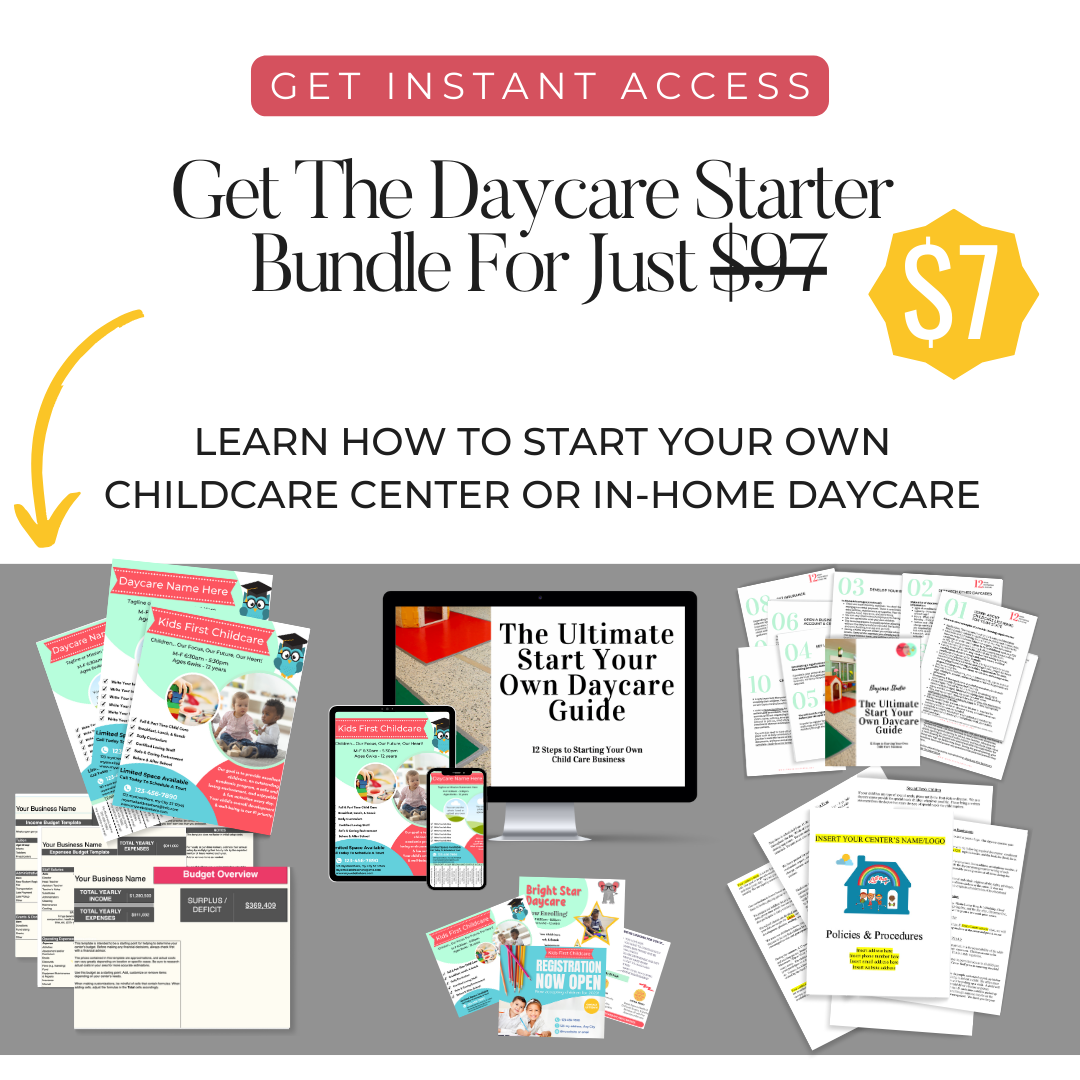
Before we get started on the policies, don't forget to snag my Daycare Starter Bundle to start your own childcare business for only $7 🙌
✅ Get my 12-step guide to starting your own center or in-home daycare. It covers everything from market research to enrollment strategies.
✅ Plus, receive two state-approved editable parent handbooks, ensuring your policies are in line with state requirements.
✅ Download a budget template to determine your expenses, income, and profitability.
✅ Get my Advertising Bundle to spread the word about your amazing services and fill your enrollment spots!
No more procrastination or feeling overwhelmed!
Now, read on to discover the 30 Daycare Policies You Need In Your Parent Handbook
Admission Requirements
This policy should detail the requirements for admission to your child care center and the process for enrolling a child. For example, include what ages you accept, what forms are required to enroll, such as the enrollment forms and current immunization record, and any required fees, such as a registration fee and book or curriculum fee.
2. Tuition and Payment Policy
This policy should detail your tuition rates, how you will bill parents for childcare services, what forms of payments you will accept, and your policy on late payments. In addition, include information on any discounts you offer, such as a sibling discount and the absent rate policy, if any.
3. About Us
This isn't a policy, but make sure to include a short paragraph about your program, what it believes in, and the vision you have for your families and community.
4. Hours of Operation
This policy should detail the days, and hours your child care center is open.
5. Holiday Closings
I have a separate section listed in my parent handbook for holiday closings. My policy reads like this "We are closed for the following holidays: New Year's Day, Martin Luther King Jr.'s Birthday, Good Friday, Memorial Day, Fourth of July, Labor Day, Thanksgiving Day, and the day after, Christmas Eve, and Christmas Day. If the holiday falls on a weekend, we will close the Friday before or Monday after. If we close for any other reason, you will be given a two-week prior notice."
6. Inclement Weather
Detail how you will decide on closing for inclement weather and how you will notify parents. Most programs follow their local school system for inclement weather closings.
7. Child Drop Off & Pick Up Policy
This policy should detail the process for dropping off and picking up children. In addition, you should consider implementing a cut-off time such as 9:00 or 10:00 am for dropping off children, unless prior approval or a doctor's excuse.
You will want to include that children should be escorted to their class or room by an adult and not be dropped off in the parking lot or outside the facility, along with the policy for releasing children to authorized pick-ups only.
8. Late Pick-Up Policy
Make your late pick-up fee hefty, and consider having a policy that states that the family will be subject to termination after three late pick-ups within 30 days.
An example late fee policy may look like this: “The charge will be $15 for the first 5 minutes and $2 per minute thereafter. If we have not been in contact with a parent or guardian and the child has not been picked up within 1 hour, we are obligated to inform the Division of Family and Children Services and the appropriate local authorities. Any family with more than three late pick-ups within 30 days will be subject to termination.”
9. Parental Access
Will you have an open-door policy allowing parents to visit the center unannounced whenever their child is in care? Check with your state's requirements and detail this policy in your parent handbook.
10. Sick Child Policy
This policy should detail what you will do if a child becomes sick at your childcare center. Include procedures for parents to follow if their child is sent home sick and policies on when a child can return after being ill.
11. Camera Access
If you have classroom cameras, let parents know if they can view their child throughout the day and how to log in. If the cameras are for security purposes only, detail that policy.
12. Nap Time
Detail your scheduled nap times for infants, toddlers, and preschoolers. Include what you provide, such as a cot or mat, and list any supplies the parents should provide, such as a blanket to be washed and returned weekly.
13. Notifiable Communicable Diseases
Certain infectious illnesses must be reported to the health department. These illnesses are referred to as notifiable communicable diseases. Have a policy explaining how you will communicate disease exposure and the protocol for notifying the local health department of notifiable diseases.

Grab my FREE Daycare Starter Guide to start your own childcare business.
If you don’t know where to start, this PDF guide to starting your own center or in-home daycare is perfect for you! Click the button to get instant access and download. It’s super easy and absolutely free!
14. Immunization
Detail your Immunization policy. Check with your state to make sure you stay in compliance. In most states, each child will need to maintain a current immunization record on file. Sometimes, a notarized exemption form can be used in place of an immunization record.
15. Staff Qualifications
This policy should detail your state requirements and qualifications for hiring staff along with the background check, annual training, and CPR & First aid certification requirements.
16. Medication Policy
This policy should detail your procedures for administering medication to children. Include what types of medicine you will administer, how parents need to provide the medication, and the documentation you require from the doctor.
17. Emergency Plans
This policy should detail your procedures for handling emergencies, including but not limited to severe weather, loss of electrical power or water and death, serious injury or loss of a child, a threatening event, or natural disaster which may occur at the child care center or daycare.
Because this information is so lengthy, I detail our safety drill schedule in this section and mention that we have a detailed copy of our emergency plans available upon request.
My policy reads like this, "The center will conduct drills for fire, tornado, and other emergency situations. The fire drills will be conducted monthly, and tornado and other emergency situation drills will be conducted every six months. In addition, the center has in place procedures for evacuation, relocation, shelter-in-place, lock-down, communication and reunification with families, and continuity of operations. A copy of our emergency plans is available upon request.”
18. Prohibited Substances
Include a policy that no person shall smoke, vape, or use tobacco or prohibited substances on the premises or in any vehicle used to transport children during operating hours.
Now before we move on, I want to talk about the heaviness of running a childcare business.
Creating policies is one more thing on your to-do list.
And it's never the only thing. It's enrollment, staff, parents, paperwork, and money, all while trying to be present for the kids you started this for. Running a childcare business is hard, and so much of it happens where no one sees it: the late nights, the texts from staff, the decisions you replay at 2am.
That's how burnout sneaks up on you. Not all at once, but one more thing at a time, until you're just getting through the day.
If that's you right now, it's not because you're doing something wrong. It's because you're carrying too much.
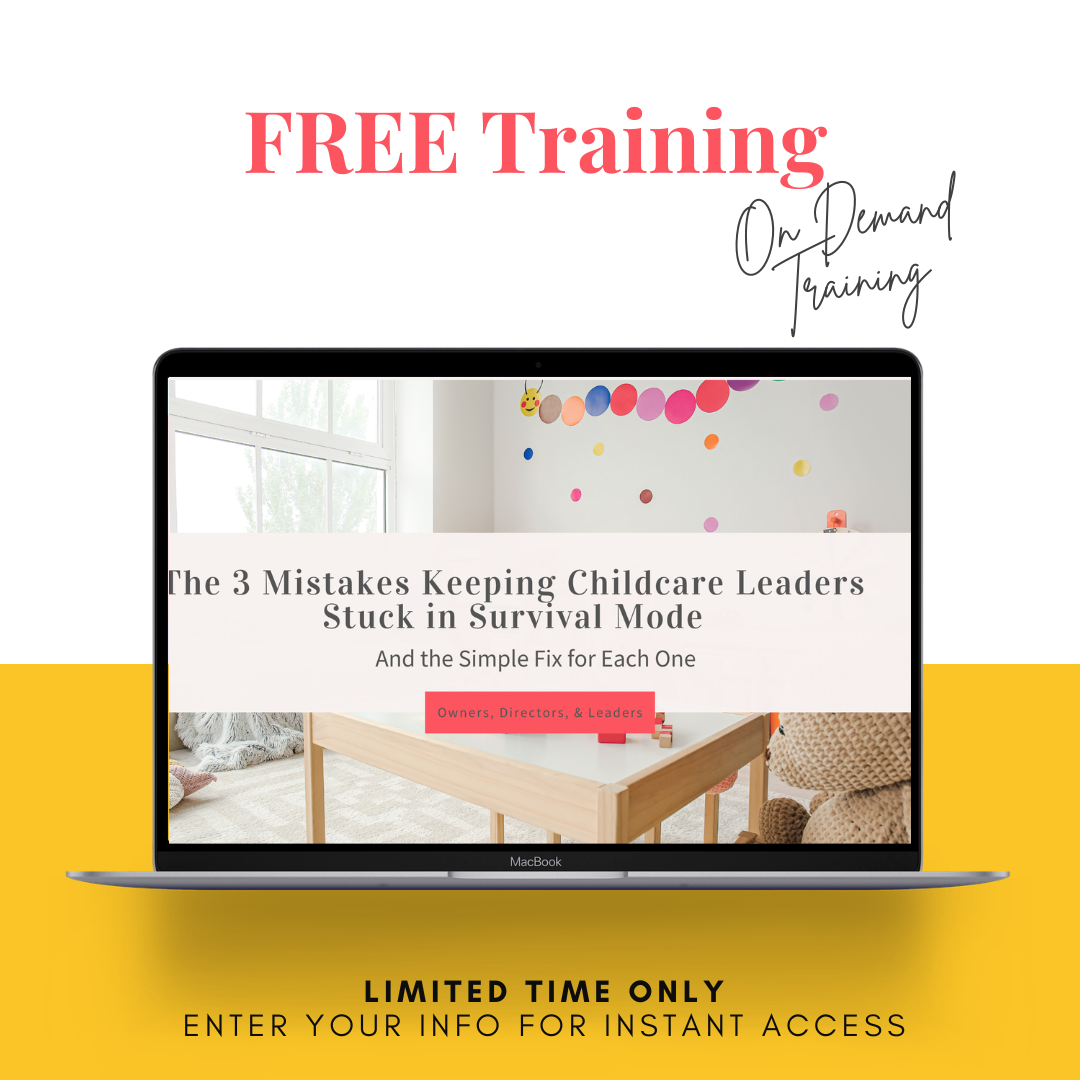
💛 Free Training: From Surviving to Thriving
That's why I created a free training called From Surviving to Thriving: The 3 Mistakes Keeping Childcare Leaders Stuck in Survival Mode. It walks you through the three mistakes I see almost every childcare leader making without realizing it, and the simple fix for each one.
I'm not going to tell you to work harder. You're already doing plenty. I'm going to show you how to make it feel less heavy.
19. Written Parental Authorization
This policy should give details on times and events that you will require written parental authorization or parental permission. For example, include that you require written permission for children to participate in routine transportation, field trips, special activities away from the daycare center, and water-related activities occurring in water more than 2 feet deep.
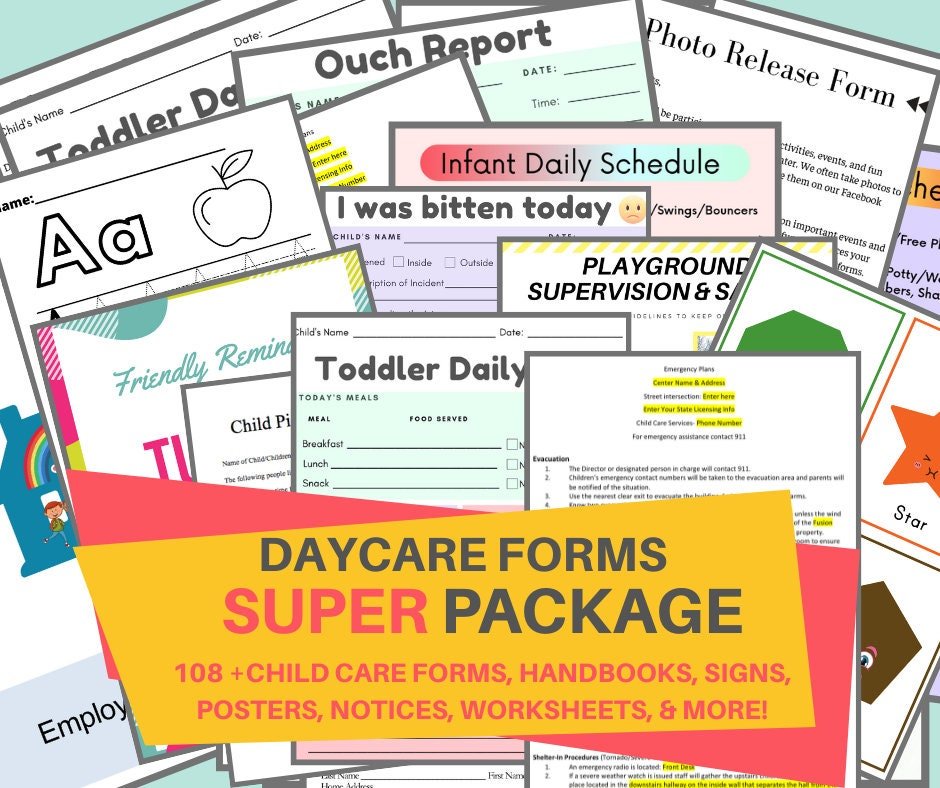
Skip the Stress and Overwhelm and Grab my Childcare Forms SUPER Package (108+ templates) to Start Your Own In-Home Daycare or Childcare Center Faster Than You Dreamed Possible!
20. Health & Safety Policy
Detail your hand washing policy for all children and staff and your cleaning and disinfecting policy for surfaces, toys, and frequently touched objects.
21. Television/Technology
Let your parents know how much television and computer time will be allowed, if any. Detail the type of children's shows that will be allowed. Check with your state licensing department to determine the regulations for your state.
22. Biting
Explain to your parents that biting is a normal stage of development and common among young children. Detail how you will communicate to both families and how you will handle a biting situation. Click here for a biting report to give to parents.
Here is my biting policy:
"Biting is a normal stage of development that is common among infants and toddlers and sometimes even among preschoolers. It is something that most young children will try at least once.
When biting happens, our response will be to care for and help the child that was bitten and to help the biter learn more appropriate behavior.
Our focus will not be on punishment for biting but on effective behaviors that address the specific reason for biting.
Supervision and prevention will be the number one way we help change the behavior.
Notes will be written to the family of the child who was bitten and the biter's family. We will work together with the families of each to keep them informed and to develop strategies for change."
Click here to find my complete Biting System Policy that includes a Biting Policy, a Parent's Guide to Biting, and a Behavior Support Plan.
23. Infant Care
Let parents know how their infant will be cared for and what is expected from them. Here are some things to cover:
Safe sleep policy
Feeding policy
What parents must provide: change of clothes, diapers, wipes and bottles prepared & labeled
24. Toddler Care
Detail your center's toddler care practices. Here are some things to cover:
Diaper changing policy
What parents must provide: change of clothes, diapers or pull-ups, and wipes
25. Special Needs Children
Include that parents should notify you of any special needs. Let parents know if you can handle special needs and the ratios you offer. I would specify that enrollment acceptance will be determined on a case-by-case basis depending on the child's needs and current staffing qualifications.
26. Curriculum & Activities
Detail your school's curriculum for each age. Let parents know what their child will learn and what to expect from your program. Highlight some activities on the schedule, such as outside times, center times, morning circle times, etc.
27. Guidance & Discipline
Explain how you will help children with behavior issues and problems. For example, will time-outs be used, or will re-direction be your primary focus? Will you use the Conscious Discipline techniques? Explain what you will do for aggressive behavior and how you will communicate with parents.
28. Parent Communication
Include your policy for communicating with parents about their child's day, diaper changes, meals, supplies needed, etc. Will you have a daily communication log or sheet? Will you provide a behavior sheet for older children? Will you use a parent app to communicate?
29. Meals
Give details of what meals your program will provide and the times of each meal. Include whether or not you will accept outside food and your procedure for food allergies.
Here is my policy: Our center will provide breakfast, lunch, and an afternoon snack. Milk or juice is served with all the meals and snacks, and water is offered throughout the day.
The meals and snacks for each week constantly vary to ensure the children receive a well-balanced diet. The children are offered food but will not be forced to eat. Our goal is to offer nutritious meals and snacks to the children in our care, as nutrition is vital to a child's health.
Children should not bring food except in case of allergies or special diets prescribed by a physician. A doctor's note is required for all food brought from home, including special milk and snacks. Food allergies can be life-threatening, and each child with a food allergy should have an action plan for emergency care completed by the family physician.
Weekly menus are posted on the bulletin board and are available at the beginning of every week. All food products are purchased weekly, bi-weekly, or monthly. The perishable products are bought fresh weekly. Our meal times are as follows:
Breakfast: 8:00 AM – 8:30 AM
Lunch: 11:00 AM – 11:30 AM
Snack: 2:30 pm – 3:00 pm
30. Child Abuse
Notify parents that you are required by law to report any suspected child abuse, child neglect, exploitation, or deprivation to the Department of Family and Children's Services. Include that if any abuse is suspected, the parents will be notified as soon as possible.
Daycare Contract
Once you have established your policies and have a parent handbook in place, you must create a parent/center agreement known as a daycare contract. The parent should sign this contract at the time of enrollment, stating that they agree to and will abide by your policies.
Let’s talk more about why having a daycare contract is a must!
Clear Expectations-Having a daycare contract that parents sign is necessary for several reasons. Firstly, it establishes clear expectations and guidelines for both the childcare provider and the parents, ensuring that everyone is on the same page regarding policies, procedures, and fees. This helps to prevent misunderstandings and conflicts down the line.
Legal Protection- A signed daycare contract provides legal protection for the daycare provider in case of disputes or disagreements. It outlines the rights and responsibilities of both parties, including terms of payment, hours of operation, and the protocol for late pickups or absences.
Transparency-A daycare contract serves as a professional agreement that fosters trust and transparency between the provider and the parents, promoting a positive working relationship built on mutual respect and understanding.
Conclusion:
This is just a basic outline of the things you may want to include in your child care center's policy manual. It is important to be as detailed as possible so that parents know what to expect from your program and ensure their child will be safe and well-cared for while in your care. Be sure to consult with your state's licensing regulations to ensure that you are including all of the required information in your policy manual.
One more thought:
And just know that you can have the best written policies in the world, but if you find yourself struggling to keep them, it's usually not the policy that's the problem. It's the moment. A parent is standing in front of you, or a teacher is texting you, and it's easier to say "it's fine, just this once" than to hold the boundary.
That's not a weakness. It's what happens when you're making every call on the spot, tired, and on your own. If that sounds familiar, Don’t forget to register for my Free Training 💜
From Surviving to Thriving: The 3 Mistakes Keeping Childcare Leaders Stuck in Survival Mode.
Reacting in the moment instead of deciding ahead of time is one of the three mistakes, and the fix is simpler than you'd think.

Download my FREE Family Screening Guide to select the families right for you.
Download this guide to help you carefully accept the right families and avoid the high-maintenance ones. Includes 13 questions and a Family Information Card for easy follow-up.


Grab my FREE Daily Schedules for Infants, Toddlers, & Preschoolers!
Download 3 PDF schedules designed for each age; Infants, Toddler, and Preschoolers. A Canva link is provided to edit the schedules for your program. It’s absolutely free and only takes 5 seconds!



Grab my FREE Daily Schedules for Infants, Toddlers, & Preschoolers!
Download 3 PDF schedules designed for each age; Infants, Toddler, and Preschoolers. A Canva link is provided to edit the schedules for your program. It’s absolutely free and only takes 5 seconds!



You weren’t meant to run a childcare business alone and now you don’t have to! ❤️

This listing includes three editable, downloadable childcare forms: a Biting Policy, a Parent's Guide to Biting, and a Behavior Support Plan. This bundle is designed for licensed daycare centers, in-home daycare providers, childcare centers, and preschools who need a professional, ready-to-use system for handling biting incidents.

This is a digital, editable, downloadable Staff Evaluation Form and Staff Self-Evaluation Form to be used to evaluate the performance of child care staff, employees, and teachers. This complete printable application is designed for licensed childcare centers, in-home daycares with staff, and preschools.

This is a digital downloadable Social Media Kit containing 79 Facebook & Instagram graphics to post to your daycare's social media pages. These graphics were designed for licensed childcare centers, in-home daycares, and preschools.

There are so many employee forms, handbooks, & documents needed to start your own daycare. Your state licensing department requires certain forms and some forms simply help your center run more smoothly and effectively. This Daycare Employee Bundle includes 17 forms to help you interview, hire, and manage employees.
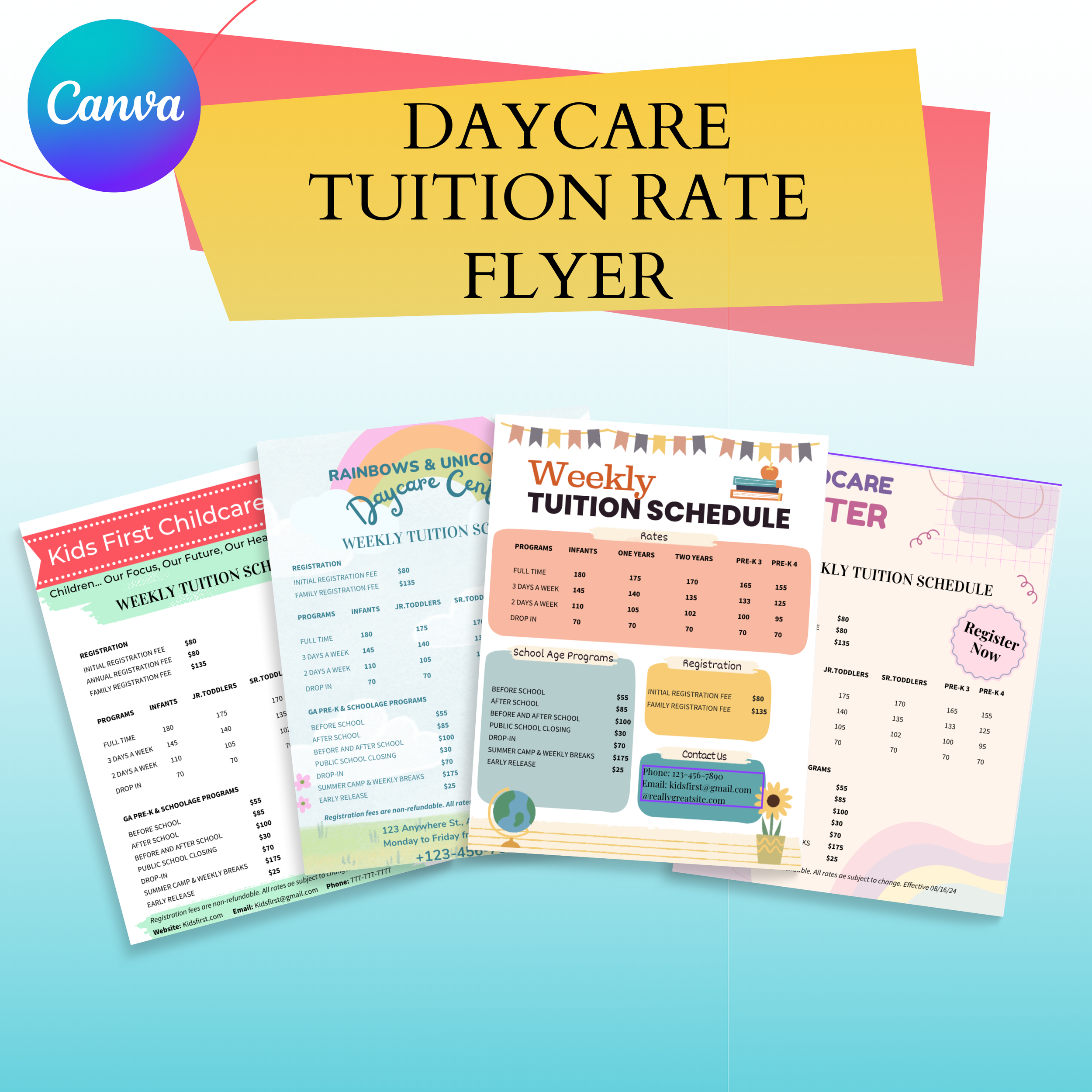
Give parents (and yourself) a clear, professional breakdown of your tuition rates without starting from scratch. This editable Tuition Rate Sheet template makes it simple to share your weekly rates, registration fees, and program pricing in a format that's easy to read and easy to update whenever your rates change.
What's included:
4 unique tuition rate sheet designs, fully editable in Canva. Pick the style that matches your center's branding, add your own rates and contact info, and you're ready to print, email, or attach to your parent handbook.
Your tuition rates already belong in your policies and procedures or parent handbook, but having them on a standalone sheet makes them easy to hand out, post in your lobby, or attach to an enrollment email without digging through a longer document.
How it works:
Purchase and download your instructions PDF
Click the link inside to open your 4 templates in Canva
Choose your favorite design, then edit your rates, fees, and contact details
Download your finished sheet as a PDF, ready to print or email
What you'll receive:
One PDF containing your links to all 4 Canva templates.
Please note:
This is a digital product, delivered as editable Canva templates, not a printable file
Nothing ships, and there's nothing to print until you've customized and downloaded your version
All sales are final
Not for resale
Questions or an issue with your download? Just message me, happy to help.

Finally! Say Goodbye to the Overwhelm of Creating Parent & Staff Letters, Emails, and Reminders From Scratch!
Get instant access to 46+ downloadable Microsoft Word & Google Doc templates for important and sensitive letters, emails, and reminders you constantly need to communicate in your childcare business.
What other policies do you have for your child care center or daycare? We want to know. We'd love to hear your feedback in the comments section below too.
Here are some other articles packed with valuable content you are sure to enjoy:
Important Forms You Need For Your New Daycare
How To Deal With Parents Who Consistently Pay Tuition Late!
The 12 Most Common Child Care Business Mistakes