This post may contain affiliate links, which means I'll receive a commission if you purchase through my link, at no extra cost to you.If you're new here, welcome! Before we get started, grab my free Fill Your Spots Enrollment Audit. It walks you through the gaps that keep families from enrolling, so you can finally fill your open spots.
Now let's dive into how to manage burnout for childcare owners and directors.
I was sitting in my car in the parking lot of my own center with the engine still running. And I couldn’t make myself go inside.
Too many people had called out. Again. It was happening almost every single day, and I already knew exactly what my day was going to look like before I ever opened that door.
I did go in that morning. Something changed that year, and I stayed for a long time after it. The systems I teach today came out of the hardest year I ever had, a year of full-blown childcare director burnout.
If you’re dealing with daycare director burnout right now, you’re not doing anything wrong. You’re carrying too much, and nobody showed you how to set some of it down.
Here are five things from that year changed for me.
At the end, I’ll tell you what finally made me turn off the car and walk inside.
1. I stopped letting call-outs run my whole building
I rarely covered a classroom myself. I did on occasion. But every time someone called out, my assistant and my floaters got pulled into classrooms, and that left me running everything else by myself.
Mops and brooms. Restroom breaks for teachers, constantly. The after-school pickups. Answering phones. Giving tours. Day in and day out. Some days we had to combine classrooms just to stay in ratio. I had zero help, because we were stretched so thin. On paper, I was the director. In real life, I was whoever the building needed in that minute.
When call-outs pull your support team into classrooms, the director becomes the support team. You can’t be the plan for everything every day for years. Eventually it costs you your health or your time with your family.
So I started over-hiring. Once my key teachers were in place, I hired extra part-time people and subs who were happy with flexible hours. Then I built what became my Staff Attendance Booster formula:
• Educating staff on what a call-out does to everyone else
• Rewards for great attendance
• A clear attendance policy
• Flexible time off with a seven-day notice
Little by little, the call-outs slowed down. My floaters could float again. My assistant got back to her own work. And I wasn’t the one holding the mop at five o’clock anymore.
Want the exact attendance policy I used in my own center? Grab my free Staff Attendance Policy Template here.
2. I said yes to help
For years, I believed it was faster to just do it myself. I was proud of that. I knew where everything was, and I could do every job in that building.
What that really meant was that every job in that building needed me, and I was running out. Every job I held onto was one more thing standing between me and the work only I could do.
So I started handing off roles. One of them was our break room. I asked one of my toddler teachers to take it over, keeping it stocked and doing the store runs, and I added a couple of hours to her time card. It sounds tiny. But it was one less thing in my head, and she loved it.
I kept going. An Enrollment Specialist. A Social Media Manager. A Curriculum Coordinator. Mentors for each age group. Every role I handed off gave me back a little more of myself, and my team felt trusted, which made them want to stay.
3. The one thing I never had: people who got it
This is the hardest one for me to talk about.
For a long time, I didn’t talk to anybody about how hard it was. The other directors and centers in our area saw us as competition. And honestly, I didn’t know anybody else doing this job. My staff needed me to be steady, so I kept it all to myself.
I was carrying it alone. And alone is heavy.
Nobody understands this job like someone else doing it. Someone who knows what it feels like when three people call out before seven in the morning. Someone you don’t have to explain ratios to. I never had that, and looking back, I wish I had. It would have made that year so much lighter.
If you’re in a town where the other centers see you as competition, I understand. That was me. It’s exactly why I built the Childcare Leaders Circle, a community of owners and directors who get it, with the tools and support I wish I’d had that year.
4. I made self-care non-negotiable
This is the one I fought the hardest.
For years, I took care of everyone in that building except me. I’d skip lunch. I’d skip my walk. I told myself I’d rest when things calmed down, and things never calmed down.
So I started treating my self-care like any other appointment on my calendar. It didn’t get moved, and it didn’t get skipped. Every morning started with my coffee, slow and quiet, before the day got loud. And every single day, I took my walk and got my thirty minutes of exercise in. Even on the hard days. Especially on the hard days.
If stepping away feels impossible, tell your assistant plainly:
“I’m heading out for my walk. I’ll be back in thirty minutes. Call my cell if there’s a true emergency, and everything else can wait until I’m back.”
I’m a planner and an introvert, and I need calm to lead well. When I took care of myself, I walked into that building calm, and my whole team felt the difference. Those daily walks did more for my daycare director burnout than any vacation ever did.
I fought this one because it felt selfish. Walking out the door while we were stretched thin felt like abandoning my center. But my center did just fine, and I came back with more to give.
If you’re thinking you don’t have time, start smaller than you think. Ten minutes for a walk around the block, or your coffee before you open your email. Protect that time the way you’d protect a tour.
5. I remembered why I started
Somewhere in all the call-outs and the mops, I’d stopped seeing the children. I was seeing ratios and schedules. I wasn’t seeing faces anymore.
And here’s the funny part. I was in and out of those classrooms all day long, giving restroom breaks. I was right there with the children. I just wasn’t really there.
So here’s what I want you to do. The next time you walk into a classroom, whether it’s to give a restroom break, talk with a teacher, do a quick class check-in or drop off supplies, sit down for a few minutes. Get on their level. See what they’re building. Ask them what they’re working on, and have a real conversation with them.
A few minutes on that rug will remind you why you said yes to this work in the first place. Those little faces are the reason we do all of it.
While you’re in there, try a positive only classroom visit for your teachers too. Walk into a room and only say something good. It takes thirty seconds, and your teachers will remember it all week.
“Ms. Amy, the way you calmed Jayden down during that transition just now was beautiful. Thank you for that.”
What made me walk inside that morning
I looked up, and one of our preschool families was walking in. The little girl saw my car and waved at me with both hands, like I was the best thing she’d seen all week. And I thought, I’m not done yet. I just can’t keep doing it this way. So I turned off the car, walked inside, and started changing things that same week.
Here’s what changed:
1. I stopped letting call-outs run my whole building.
2. I said yes to help.
3. I learned what it costs to do this alone.
4. I made self-care non-negotiable.
5. I remembered why I started.
Daycare director burnout is a sign you’ve been carrying too much for too long, and it’s something you can change. If you’re in that parking lot season right now, you’re not alone. Come join us in the Childcare Leaders Circle.
Take one thing from this post. Just one. Hand off one task this week, or take one walk that’s just for you. Start there.
For more of what I learned over 21 years, check out I Ran a Daycare for 21 Years. Here’s What I’d Never Do Again.
Frequently asked questions
What are the signs of childcare director burnout?
Dreading the drive in. Skipping lunch and breaks so often you stop noticing. Feeling like you’re running the building instead of leading it. Snapping at people you care about. Seeing ratios and schedules instead of the children. If several of these sound familiar, you’re carrying too much, and it’s time to start handing some of it off.
What causes daycare director burnout?
Most directors burn out from carrying too much for too long. Call-outs pull support staff into classrooms, and the director picks up everything else. Doing it alone makes it heavier.
How do you prevent burnout as a childcare director?
Fix the call-outs first with over-hiring and a clear attendance system. Then hand off real roles to your team, and treat your self-care like any other appointment on your calendar.
How do I stop doing everything myself at my daycare?
Start with one role. Find the team member who’s already doing something well and give it a title. Add a few hours to their time card if the role needs it. Then keep going, one role at a time.
Where can childcare directors find support?
Look for a community of owners and directors who understand the job. If the centers near you see you as competition, an online community like the Childcare Leaders Circle gives you people who get it.
Before You Go:
If you're feeling overwhelmed with everything it takes to run a childcare business, you're not alone in that.
The enrollment. The staff. The parents. The paperwork. The policies. The money.
Most of us started this because we love kids, not because we wanted to be a full-time HR manager, bookkeeper, and marketer. And when you're doing all of it by yourself, it can start to feel like you're barely keeping your head above water.
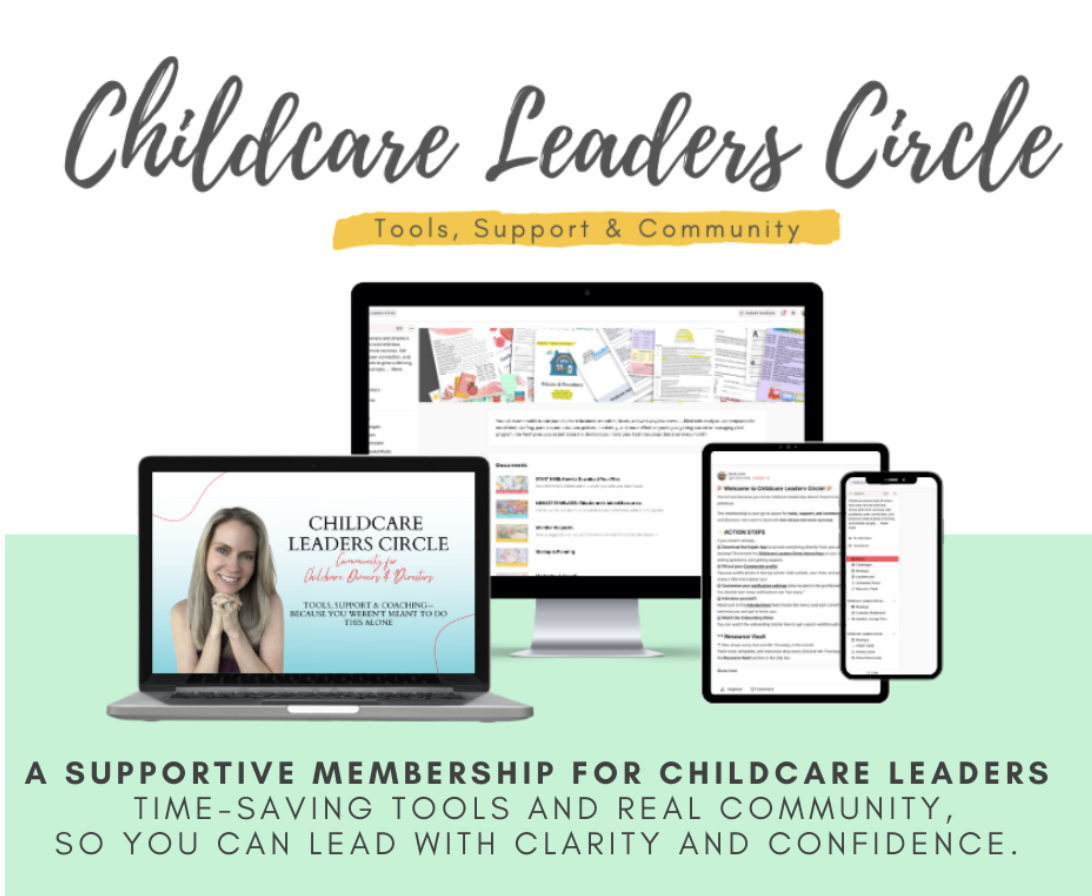
That's why I created the Childcare Leaders Circle.
It's a membership community for childcare owners and leaders who are done figuring it out alone. Inside, you get real support from people who understand exactly what you're dealing with, plus done-for-you tools and templates so you're not starting from scratch every time something comes up.
You don't have to carry all of it by yourself.
Here are some other articles packed with valuable content you are sure to enjoy:
10 Ways To Increase Revenue In Your Daycare Business
6 Must-Do’s To Effectively Communicate To Staff
How To Avoid Burnout in Childcare
How To Screen Families For Your Daycare
6 Tips To Ace Your Licensing Inspections
30 Daycare Policies You Need in Your Parent Handbook
Important Daycare Forms You Need For Your Childcare Business
How To Deal With Parents Who Consistently Pay Tuition Late!
The 12 Most Common Child Care Business Mistakes
One Surefire Way to Boost ECE Staff Retention

Download my FREE Family Screening Guide to select the families right for you.
Download this guide to help you carefully accept the right families and avoid the high-maintenance ones. Includes 13 questions and a Family Information Card for easy follow-up.


Grab my FREE Daily Schedules for Infants, Toddlers, & Preschoolers!
Download 3 PDF schedules designed for each age; Infants, Toddler, and Preschoolers. A Canva link is provided to edit the schedules for your program. It’s absolutely free and only takes 5 seconds!



Download my FREE Daycare Starter Guide to start your own childcare business.
If you don’t know where to start, this guide is perfect for you! Click the button to get instant access. It’s super easy and absolutely free!




Grab my FREE Fill Your Spots Fast Enrollment Audit and quickly uncover what’s missing in your process so you can start filling your open spots consistently.