This post may contain affiliate links, which means I'll receive a commission if you purchase through my link, at no extra cost to you.If you're new here, welcome! Before we get started, grab my free Fill Your Spots Enrollment Audit. It walks you through the gaps that keep families from enrolling, so you can finally fill your open spots.
Now let's dive into how to create a 90 day plan to keep your new childcare teachers.
Years ago, I hired a teacher I was so excited about. Great interview. Great references. We were so short-staffed that I gave her one morning of training and put her in the toddler room that same afternoon.
Three weeks later, I got a text at 5:40 in the morning. She wasn’t coming back.
Here’s what hurt. She was a good hire. I set her up to fail in her first week. Years later I ran into her at the grocery store, and what she told me changed how I trained every new teacher after that. I’ll share it at the end of this post.
If your new hire starts Monday and you have no idea how you’ll train her while you’re already short-staffed, you’re not doing anything wrong. Nobody gave you a plan for the first 90 days. After 21 years as a childcare center director, here’s the daycare staff training plan I used, from before she walks in the door to the day 90 conversation that kept my best teachers.
1. Before day one: get ready for her
Your new hire is nervous. She’s wondering if she made the right choice, so the first impression matters more than you think.
Have her employee file set up and a small welcome gift on the table before she arrives. Most important of all, pick her mentor.
Never have a new hire train with a C-rated employee. If your new teacher learns from someone who cuts corners, you’ll get another teacher who cuts corners. Think about making a copy from the master copy instead of a copy of a copy of a copy. Put her with your best.
Tell your team she’s coming, too. Put her name on the staff board. When she walks in and people already know her name, she relaxes. Send her a welcome text the Friday before:
“Hi Brittany, we’re so excited for you to start Monday. Come in at 8:30 and ask for me at the front desk. Wear comfortable clothes you can sit on the floor in. Can’t wait to see you.”
2. Day one: a big welcome and a real orientation
Give her a big welcome and a quick tour. Then sit down somewhere private. I always used our break room with a sign on the door that said Orientation in Progress, and I offered her a water and a snack.
Yes, a real orientation takes time. Put it on your calendar like an appointment, because it’s part of what keeps her.
I walk through orientation using my six-step framework. Start with 45 minutes to an hour for her to read the employee handbook and fill out her paperwork. While she does that, make copies of her ID and her credentials for her file.
Then go over your most important policies out loud, every time. Your voice walking her through each policy is what makes it stick.
End orientation by talking through her professional growth plan, then tell her exactly what her week will look like:
“So here’s your week. Today and tomorrow, you’ll mostly watch and ask questions with Ms. Amy. By Wednesday, you’ll start jumping in. I’ll check in with you at the end of every day. If you need me before then, text me anytime.”
3. Week one: her mentor steps back a little each day
This is where most centers lose new teachers, and I was guilty of it. When you’re short-staffed, it’s so tempting to give a new hire a one-day crash course and leave her on her own. Nobody can learn everything in one day.
Here’s how I trained every new teacher in her first week:

Use that first week to cover the how-tos: how to change a diaper the right way, how to fill out an ouch report, how to greet parents at drop-off and how to handle a biting situation. If you have short training videos, assign a few each day. Once you record them, they’re done, and every new hire gets the same training.
At the end of every single day, check in. Two minutes is enough.
“Tell me how today went. Is there anything you need from me for tomorrow?”
Those two minutes tell her she matters. They also tell you if something’s going wrong while you can still fix it.
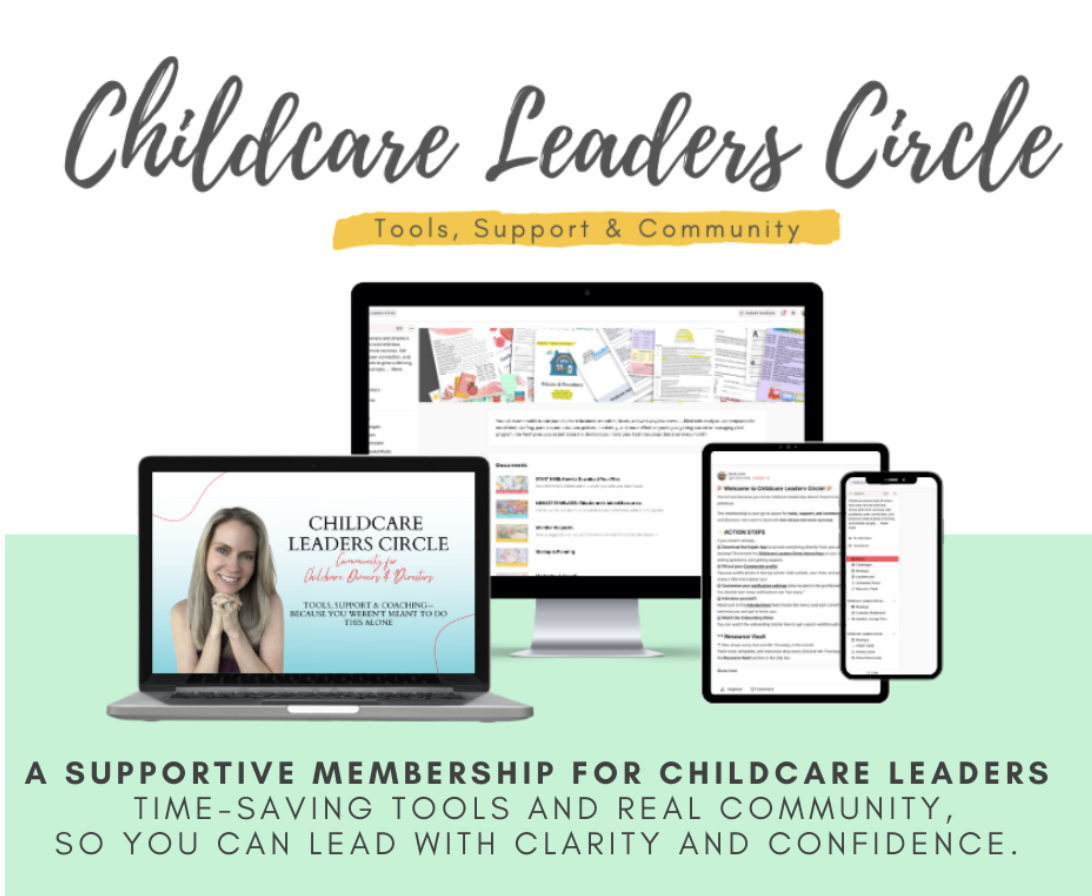
This is a lot to build from scratch when you’re already covering a classroom. Inside the Childcare Leaders Circle, you’ll find my onboarding templates, ready to download and use this week, plus a community of directors training new hires right alongside you.
4. Weeks two through four: solo with check-ins
In week two, if she’s ready, she works on her own with hourly check-ins from her mentor or a supervisor. If she’s not ready yet, that’s okay. Keep the supervised training going a little longer. Ready matters more than fast.
If you’re stretched thin, ask a couple of teachers to pick up a little overtime for two weeks so her mentor can stay with her. That costs less than starting the hiring process all over again.
At the end of week two, send a quick check-in email. At the end of week four, sit down for a 20-minute one-on-one. Ask how she’s feeling and what you can do to support her. Set up any training she still needs, like CPR and first aid. And give her a little one-month anniversary gift, something small that says we noticed.
“Brittany, you’ve been with us a whole month, and I want you to know the kids already light up when you walk in. What’s been going well? And what’s one thing I could do to make your job easier?”
5. Days 30 to 90: make her part of the team
This is when a new teacher decides if she belongs here. Include her. Add her to your private staff Facebook group, and when she lives one of your core values, give her a shout-out by name at your next staff meeting.
Make sure her state required training is on the calendar. In Georgia, for example, new staff have to become CPR and first aid certified and finish the Health and Safety training within 90 days. Check your state, because every state is different.
The day 90 conversation
This is the step almost every director skips, and it’s the one that kept my best teachers with me. At day 90, sit down with her one more time. Ask her what she loves about working here, and what would make her leave. Then listen.
“You’ve been here 90 days now, and I’m so glad you’re on our team. I want to make sure you stay for a long time. What do you love most about working here? And if anything ever made you think about leaving, what would it be?”
Teachers rarely tell you what’s wrong until they’ve already decided to go. This conversation gives them a safe place to tell you while you can still do something about it. Ask while she still wants to stay.
What she told me at the grocery store
She said, I really liked working there. I just never felt like I knew what I was doing, and I didn’t want to hurt one of the kids. That one sentence stuck with me. What she needed was a better first week. After that, every new teacher I hired got one.
Here’s your first 90 days at a glance:
1. Before day one: pick her mentor and get ready for her.
2. Day one: give her a real orientation.
3. Week one: she goes from watching her mentor to running the room.
4. Weeks two through four: she works solo with check-ins and a one-month sit-down.
5. Days 30 to 90: make her part of the team and have the day 90 conversation.
Good daycare staff training is what turns a new hire into the teacher who’s still with you five years from now. You’re already doing the hard part. You found someone. Now you have the plan to keep her.
If you want my onboarding templates ready to go, they’re waiting for you inside the Childcare Leaders Circle. And if you’re losing teachers who’ve been with you longer than 90 days, check out 5 Reasons Your Daycare Staff Keeps Quitting.
Frequently asked questions
How long should daycare staff training take?
Plan on the first 90 days. The first week moves a new teacher from observing to running the room with her mentor nearby. Weeks two through four are solo work with check-ins, and days 30 to 90 cover state required training and making her part of the team.
What should a daycare orientation include?
Give her time to read the employee handbook and fill out paperwork, then walk through your most important policies out loud. End with her professional growth plan and exactly what her first week will look like.
Why do new daycare teachers quit early?
Many quit because they never felt prepared. A one-day crash course leaves a new teacher on her own before she knows what she’s doing, and training with a weak mentor teaches her the wrong habits.
What is a 90-day check-in for daycare staff?
It’s a sit-down at day 90 where you ask a new teacher what she loves about working there and what would make her leave. It gives her a safe place to raise problems while you can still fix them.
Before You Go:
If you're feeling overwhelmed with everything it takes to run a childcare business, you're not alone in that.
The enrollment. The staff. The parents. The paperwork. The policies. The money.
Most of us started this because we love kids, not because we wanted to be a full-time HR manager, bookkeeper, and marketer. And when you're doing all of it by yourself, it can start to feel like you're barely keeping your head above water.
That's why I created the Childcare Leaders Circle.
It's a membership community for childcare owners and leaders who are done figuring it out alone. Inside, you get real support from people who understand exactly what you're dealing with, plus done-for-you tools and templates so you're not starting from scratch every time something comes up.
You don't have to carry all of it by yourself.
Here are some other articles packed with valuable content you are sure to enjoy:
10 Ways To Increase Revenue In Your Daycare Business
6 Must-Do’s To Effectively Communicate To Staff
How To Avoid Burnout in Childcare
How To Screen Families For Your Daycare
6 Tips To Ace Your Licensing Inspections
30 Daycare Policies You Need in Your Parent Handbook
Important Daycare Forms You Need For Your Childcare Business
How To Deal With Parents Who Consistently Pay Tuition Late!
The 12 Most Common Child Care Business Mistakes
One Surefire Way to Boost ECE Staff Retention

Download my FREE Family Screening Guide to select the families right for you.
Download this guide to help you carefully accept the right families and avoid the high-maintenance ones. Includes 13 questions and a Family Information Card for easy follow-up.


Grab my FREE Daily Schedules for Infants, Toddlers, & Preschoolers!
Download 3 PDF schedules designed for each age; Infants, Toddler, and Preschoolers. A Canva link is provided to edit the schedules for your program. It’s absolutely free and only takes 5 seconds!



Download my FREE Daycare Starter Guide to start your own childcare business.
If you don’t know where to start, this guide is perfect for you! Click the button to get instant access. It’s super easy and absolutely free!




Grab my FREE Fill Your Spots Fast Enrollment Audit and quickly uncover what’s missing in your process so you can start filling your open spots consistently.